Interested In This Footage?
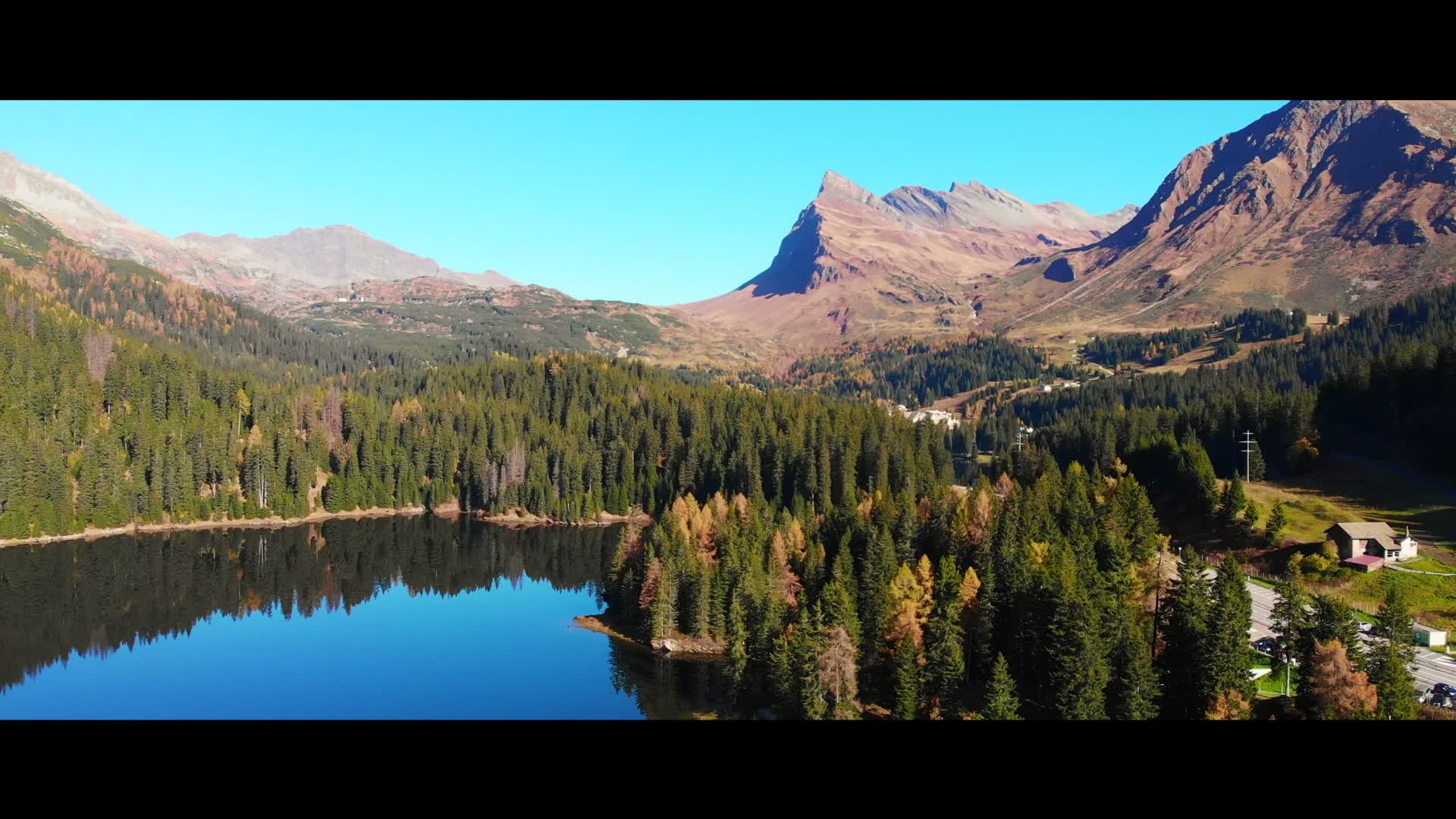
San Bernardino Pass - Pian Doss - Mesocco Castle (Grisons, Switzerland)
- about 6 years ago
- 352 VŪZ
9 


- 10
- Report
San Bernardino Pass (Italian: Passo del San Bernardino, German: Bernhardinpass, 2,066 metres (6,778 ft)) is a high mountain pass in the Swiss Alps connecting the Hinterrhein and the Mesolcina (Misox) valleys between Thusis (canton of Graubünden) and Bellinzona (canton of Ticino). Located in the far eastern side of the Western Alps it is not to be confused with the Great St Bernard Pass and the Little St Bernard Pass. The top of the pass represents both the Italo-German language frontier and the watershed (drainage divide) between the Po basin and the Rhine basin. The route first became important as a mule track in the fifteenth century when the route between Thusis and Splügen was known as the Via Mala. A road for wheeled vehicles was opened in 1770; this road was significantly improved between 1821 and 1823, financed in part by the Kingdom of Sardinia, keen to improve a trade route connecting Genoa and Piedmont to the Graubünden that was not directly controlled by Austria. Traffic flow was much facilitated when in 1967, the San Bernardino road tunnel was completed, since then vehicle traffic on the pass has been reduced, benefiting those taking the time to avoid the tunnel. The pass road is only open in summer. Lagh Doss is a lake at San Bernardino in the Val Mesolcina of the Grisons, Switzerland. It is located at an elevation of 1652 m. The site is listed in the Federal Inventory of Raised and Transitional Bogs of National Importance. Mesocco Castle is a ruined castle in the municipality of Mesocco of the Canton of Graubünden in Switzerland. It is a Swiss heritage site of national significance. The Castel ruins are among the largest in the canton. Originally the seat of the noble family von Sax, from the 12th century until 1480 it was held by the Freiherr of Misox/Mesocco. From 1480 until 1549 it was held by the Trivulzio family. A small fortified church, the Church of S. Carpoforo, was built on the hill top around the 7th century as a refuge castle for the surrounding villages. Around 1000, the fortifications around the church began gradually expanding and a bell tower was added to the church. A bergfried was added between 1150 and 1200, changing the shape and location of the walls. By the 12th century the fortified church and occasionally used fortifications had expanded into a permanently occupied castle with a nobleman who ruled over the nearby valley. By 1219 it was mentioned as Mesocco Castle. In the 13th century the castle was expanded again. A ring wall now encircled the entire hill top and a large residential wing was added to the tower. Around 1400 the residential wing was expanded and now formed an inner castle with the tower. The first ruler of the castle was the local Baron of Sax/Misox, who by the 13th century ruled over the entire Val Mesolcina and controlled a number of castles. By the end of the century, the baron's power crossed over the San Bernardino Pass and by the 14th century they reached the peak of their power. Baron Albert von Sax-Misox was a founding member of the Grey League and the family's future looked bright. However, Albert's murder in 1406 led to the gradual decline of the family. In 1480 they sold Mesocco castle and its associated demesne to General Giacomo Trivulzio. Trivulzio had been sent by Milan to acquire the castle and strengthen their claims in the strategic valley. After he paid a deposit on the castle and occupied it, he refused the pay the remainder of the agreed upon price of 16,000 Rheingulden. In 1483 the Baron of Sax and local forces besieged the castle in an unsuccessful attempt to force Trivulzio to pay. However, over the following years, he broke with Milan and paid the remaining money to improve local relations. In 1490 Trivulzio expanded and strengthened the castle and sited cannons on the walls. In 1496 he signed a treaty with the Grey League to support them with weapons and supplies in the event of a war, which he was called to do during the Swabian War and Musso War. Despite the extensive fortifications, in 1526 the newly formed Three Leagues ordered the castle abandoned and moved the administrative center of the valley to Palast Trivulzio in Roveredo. The castle fell into ruin until 1925-26 when it was excavated and reinforced. A further project in 1986-90 restored a polygonal tower and northern and north-western walls.
Up Next
San Bernardino - Winter Edition ❄️ (Grisons, Switzerland)

- Kpax
- 801 VŪZ
11 - 12
- almost 5 years ago
Pizzo Uccello - Peak of the Bird (Grisons, Switzerland)
- Kpax
- 786 VŪZ
9 - 8
- over 3 years ago
San Bernardino Pass - Winter Edition ❄️ (Grisons, Switzerland)
- Kpax
- 531 VŪZ
4 - 3
- over 1 year ago
🏔️ San Bernardino Pass, Switzerland Drone Flight Video | World from Above

- worldfromabove
- 948 VŪZ
0 - 0
- almost 2 years ago
SWISS ALPS 4K - Amazing flight over San Bernardino Pass (Switzerland)

- alpenschauen
- 805 VŪZ
17 - 13
- almost 5 years ago
Lake Trescolmen (Grisons, Switzerland)
- Kpax
- 575 VŪZ
6 - 7
- about 2 months ago
Julierpass - Autumn Edition 🍁(Grisons, Switzerland)
- Kpax
- 643 VŪZ
7 - 3
- about 4 years ago
Julierpass - Spring Edition 🌸 (Grisons, Switzerland)
- Kpax
- 1.3k VŪZ
4 - 3
- over 3 years ago
Lake Lunghin (Grisons, Switzerland)
- Kpax
- 790 VŪZ
7 - 12
- over 1 year ago
Pizzo Cassinello (Ticino/Grisons - Switzerland)
- Kpax
- 680 VŪZ
9 - 10
- 3 months ago