Interested In This Footage?
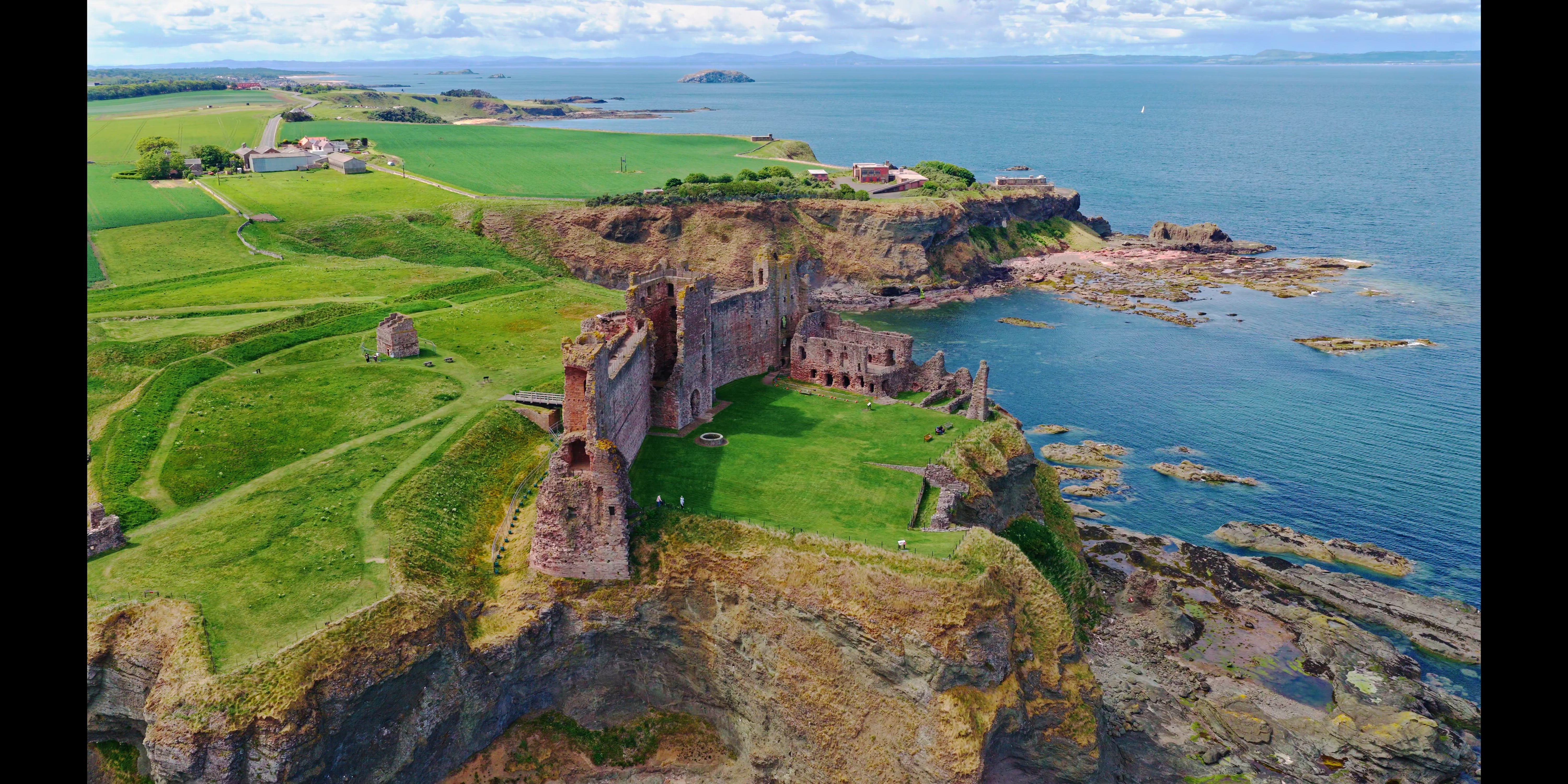
Tantallon castle and The Bass Rock, 06 06 2025 Mavic 4 Pro
- 6 months ago
- 131 VŪZ
6 


- 5
- Report
Bass Rock The Bass Rock Lighthouse is located about 3 miles north east of North Berwick. The rock is a steep crag on the southern entrance to the Firth of Forth. It is an important nesting ground for seabirds. History Prior to the construction of the lighthouse in 1902, under David Alan Stevenson, the engineer’s cousin and renowned author, Robert Louis Stevenson, wrote of the Bass Rock in his 1893 novel, Catriona: It was an unco place by night, unco by day; and there were unco sounds; of the calling of the solans, and the plash of the sea, and the rock echoes that hung continually in our ears. Bass Rock is a volcanic plug at the southern entrance to the Firth of Forth, approximately 3 miles north-east of North Berwick. It rises from the water to a maximum elevation of 351 feet and measures approximately 1 mile in circumference The rock has a rich history and has long been a site of geological, theological, and ornithological interest. A natural tunnel runs through the phonolitic trachyte rock from east to west, to a depth of 105 metres, and is only accessible at low tide. The rock is an important nesting ground for seabirds and is protected as a Site of Special Scientific Interest (SSSI). It is home to shags, guillemots, razorbills, cormorants, puffins, eider ducks, and the world’s largest colony of northern gannets (Morus Bassanus). The colony comprises between 30,000 and 40,000 breeding pairs. For centuries, the gannets of the Bass Rock have been famous both for their numbers and as food. Find out more about the birds of the Bass from the Scottish Sea Bird Centre at North Berwick: Scottish Seabird Centre c.608-757: The ‘Apostle of the Lothians’, Saint Baldred died on Bass Rock, where he had kept his cell. 1316: The first written affirmation of ownership shows that the rock was given to the Lauders by William de Lamberton, Bishop of St Andrews, in this year. The rock remained in the ownership of the Lauders for several hundred years. 1493: A papal bull dated 6 May indicates that the now ruined Pre-Reformation chapel had recently been erected on the rock, on what is believed to be the site of Saint Baldred’s cell. 1542: The chapel was reconsecrated and dedicated to Saint Baldred. 1671: Charles I claimed the Bass Rock as Royal Property and it was sold to the crown for the sum of £4,000 sterling by the then owner, Sir Alexander Ramsay of Abbotshall, Provost of Edinburgh. 1672-1688: Under another Lauder (dale), known as the Captain of the Bass, the fortress was turned into a prison for Presbyterian ministers. Approximately 40 political and religious prisoners died in dungeons on the rock. 1691: During the reign of William and Mary, a party of four Jacobite prisoners escaped from their cells and captured the fortress when all the garrison was engaged in unloading coal. For the next three years they held the Bass for the Old Pretender and defied all attempts by Government forces to retake it. Aided by supply ships from France, this unique quartet even carried out raids on the Fife and Lothian coasts. 1694: A more effective blockage finally starved them into submission, but they negotiated favourable terms and walked out free men! The fortress continued as a State Prison until demolished seven years later. 1706: Bass Rock was sold to Sir Hugh Dalrymple and it currently remains in the ownership of his descendants. From the 18th to the early 20th Century, the rock was let out to tenants, who earned money by fishing, grazing sheep (Bass Mutton was a famous 18th Century Edinburgh delicacy), killing young sea birds, and collecting eggs. The last tenant of the Bass, a Mr Easton, was a North Berwick fishmonger. 1852: The Scottish geologist Hugh Miller published Geology of the Bass Rock. 1897: In July of this year, the Commissioners of Northern Lighthouses made the decision to erect two lighthouses on the Haddingtonshire coast, as the unlighted condition of the area was causing concern. Consequently, Barns Ness and Bass Rock lighthouses were established. 1902: Following the completion of Barns Ness Lighthouse in 1901, the engineer David Alan Stevenson commenced construction for the Bass Rock Lighthouse, which ultimately amounted to a cost of £8,087:10:4. The 13th century keep/governor’s house and other buildings within the castle were demolished for materials. A light was first shown from the Bass Rock on the evening of 1 November. It was initially powered by incandescent gas obtained from paraffin oil with a high flash point. The system functioned by using pressurised air to drive the oil from its container into a vaporiser, in which it was converted to a Bunsen gas. The gas was then used to heat a mantle (a cone/dome-shaped metal mesh), causing it to glow.
Up Next
Tantallion Castle Scotland 14 06 22

- Jaybee2786
- 1.0k VŪZ
4 - 6
- over 3 years ago
Tantallon Castle & The Bass Rock

- Albacross Imaging
- 2.4k VŪZ
31 - 26
- over 8 years ago
Seacliff to Tantallion Castle Scotland. Mavic 3

- Jaybee2786
- 875 VŪZ
8 - 9
- over 2 years ago
Our best drone shots 2020 Scotland in 4K

- Airview Scotland
- 1.1k VŪZ
15 - 10
- about 5 years ago
Greece from the Air: Methoni Castle, Peloponnese

- Viajes Lost Planet
- 1.1k VŪZ
12 - 12
- almost 6 years ago
Summer day in Warsaw City

- lsergiejew
- 1.2k VŪZ
15 - 11
- almost 5 years ago
Slovakia - TOP 12 places you need to see

- HikeTheWorld
- 4.7k VŪZ
53 - 33
- over 6 years ago
Landscapes of Montenegro

- sinaysky
- 1.0k VŪZ
9 - 9
- 10 months ago
SLOVAKIA - TOP 31 places you need to see
- HikeTheWorld
- 1.7k VŪZ
18 - 18
- about 6 years ago
Scotland: Tantallon Castle, East Lothian and Edinburgh

- seb-depp
- 1.8k VŪZ
8 - 10
- over 3 years ago