Interested In This Footage?
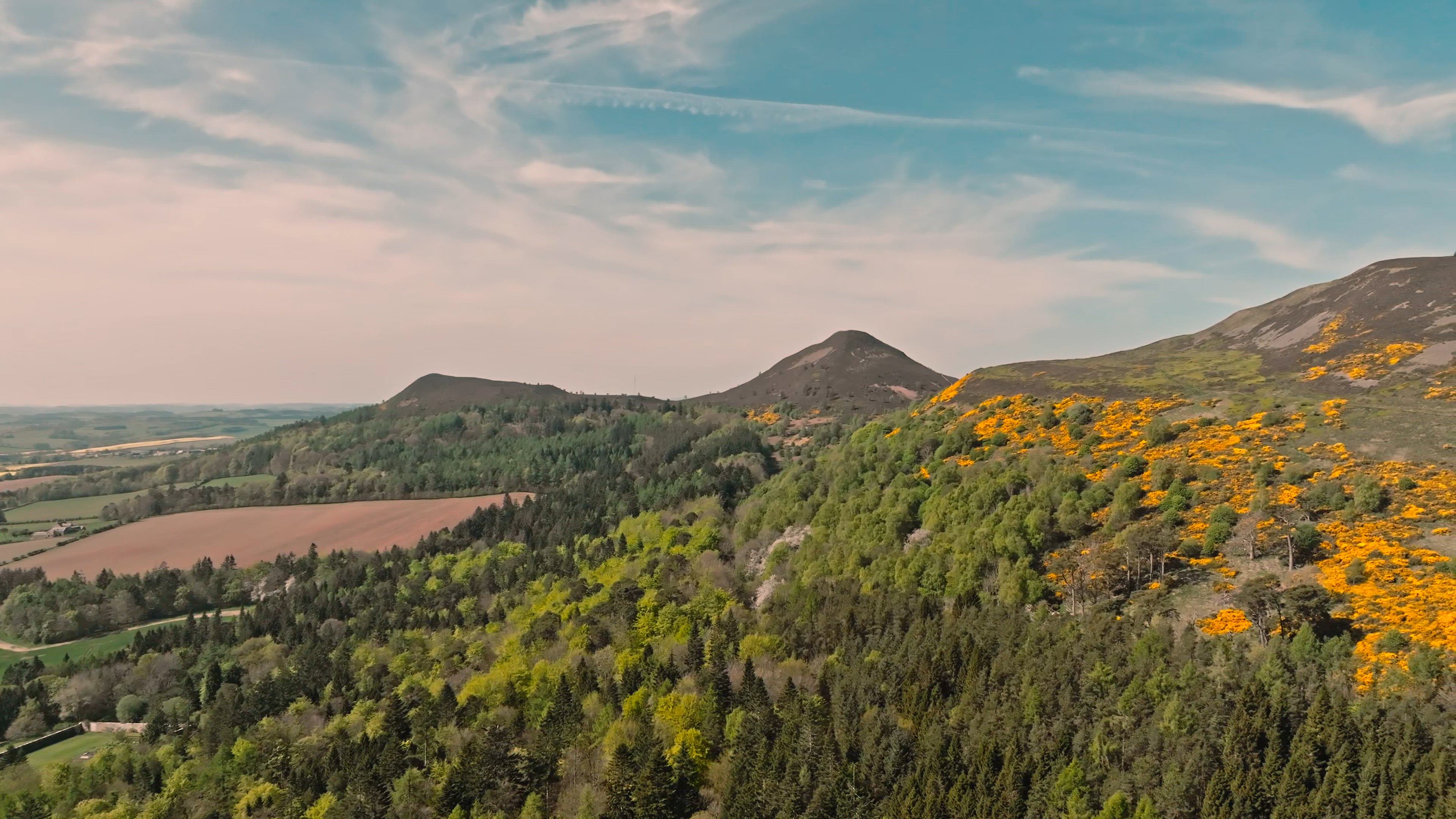
Eldion Hills Scottish Borders, 30 April 2025
- 8 months ago
- 197 VŪZ
7 


- 7
- Report
Eildon Hills, Melrose: Remnants of the Borders’ volcanic past The igneous rocks of the Eildon Hills provide evidence of widespread volcanic activity in the Scottish Borders some 350 million years ago. Sir Walter Scott’s ‘delectable mountains’ – the Eildon Hills – have long been associated with ancient Border folklore through the work of Thomas the Rhymer and his prophecies, the Arthurian legends, and Michael Scott, the wizard, featured in Sir Walter’s great imaginative work The Lay of the Last Minstrel. Indeed, Michael is attributed with splitting the Eildon Hills into three peaks with the help of an idle devilish spirit. But perhaps the geological explanation is a little more plausible – one of weathering and erosion by water and ice leaving the harder igneous rocks standing proud of the surrounding land. Overlooking the beautiful valley of the River Tweed, with Melrose lying immediately below, the three conical peaks of the Eildon Hills (North Hill, 404 m above sea-level, Mid Hill, 422 m and Wester Hill, 371 m) evoke an exciting geological and historical past. The Eildons, known by the Romans as Trimontium (the name also applied to the major fort east of the present village of Newstead) have distinctive volcanic shapes. In fact, the underlying rocks are not the original surface of a volcano but instead are the eroded remnants of a suite of igneous trachytic and rhyolitic sills – places where magma has squeezed in between the layers of sedimentary rocks and solidified, creating a layer of igneous rock. The sills in the Eildons are around 350 million years old (Early Carboniferous), and intruded into the uppermost Devonian sedimentary rock. Compositionally, the silica content of trachytes and rhyolites is much greater than that of basalts. A small prominence, called Little Hill, lying between Wester Hill and Mid Hill is the remnant of a volcanic plug now filled with agglomerate and basalt – this was probably a conduit to a small volcano. On lower ground, to the northwest of the Eildons closer to Melrose and near the Borders General Hospital, another small hill is underlain by a large vent called the Chiefswood Vent. This is filled with rock formed from fragments of sedimentary rock including Devonian sandstones and Silurian greywacke sandstones, together with fragments of trachyte and rhyolite. At the time the vent was created, the area might have been low-lying swamp, with volcanoes erupting and creating new land. The rock in the vent originated from the explosive interaction of silica-rich magmas with surface waters. The resulting brown to greenish-grey vent rock was quarried extensively in the 12th century for use in the earliest parts of Melrose Abbey. Examples can also be seen in the walls of some of the older buildings in Melrose. Local warm-coloured Devonian sandstones were also used as building stone extensively for the Abbey and in this part of the Tweed valley.
Up Next
Scott's View

- Jaybee2786
- 1.1k VŪZ
7 - 10
- over 2 years ago
Leaderfoot Viaduct
- Jaybee2786
- 778 VŪZ
0 - 0
- almost 2 years ago
Peebles Scotland March 2023
- Jaybee2786
- 669 VŪZ
10 - 9
- almost 3 years ago
Jedburgh Abbey - Scottish Borders UK

- AvariceUK
- 1.9k VŪZ
30 - 19
- over 8 years ago
Seacliff to Tantallion Castle Scotland. Mavic 3
- Jaybee2786
- 875 VŪZ
8 - 9
- over 2 years ago
Edinburgh Castle Scotland
- Jaybee2786
- 769 VŪZ
5 - 12
- 10 months ago
Abbotsford House, home of Sir Walter Scott | Borders, Scotland

- Play North
- 4.7k VŪZ
32 - 19
- about 8 years ago
Exploring the Highlands

- alex lockwood
- 4.6k VŪZ
77 - 63
- over 7 years ago
Loch Lubnaig Scotland 1
- Jaybee2786
- 722 VŪZ
2 - 2
- almost 3 years ago
Panoramic View of Edinburgh
- Jaybee2786
- 509 VŪZ
5 - 1
- over 2 years ago